what role does coagulation play in water treatment? why is it necessary to add ferric chloride?
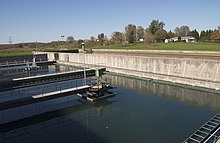
Coagulation-flocculation process in a water handling arrangement
In h2o treatment, coagulation flocculation involves the improver of compounds that promote the clumping of fines into larger floc so that they can be more easily separated from the water. Coagulation is a chemical process that involves neutralization of accuse whereas flocculation is a concrete process and does not involve neutralization of charge. The coagulation-flocculation process tin can be used as a preliminary or intermediary step betwixt other water or wastewater treatment processes like filtration and sedimentation. Atomic number 26 and aluminium salts are the near widely used coagulants merely salts of other metals such every bit titanium and zirconium have been found to be highly effective too. [1] [2]
Factors [edit]
Coagulation is affected by the type of coagulant used, its dose and mass; pH and initial turbidity of the water that is being treated; and properties of the pollutants present.[1] [3] The effectiveness of the coagulation process is besides affected by pretreatments like oxidation.[1] [4]
Machinery [edit]
In a colloidal suspension, particles will settle very slowly or not at all considering the colloidal particles bear surface electrical charges that mutually repel each other. This surface accuse is most commonly evaluated in terms of zeta potential, the electrical potential at the slipping plane. To induce coagulation, a coagulant (typically a metallic salt) with the opposite charge is added to the water to overcome the repulsive charge and "destabilize" the intermission. For case, the colloidal particles are negatively charged and alum is added as a coagulant to create positively charged ions. Once the repulsive charges have been neutralized (since opposite charges attract), van der Waals force will cause the particles to cling together (agglomerate) and form micro floc.[ citation needed ]
Determining Coagulant Dose [edit]
Jar test [edit]

The dose of the coagulant to be used tin be determined via the jar test.[1] [5] The jar test involves exposing aforementioned volume samples of the water to be treated to different doses of the coagulant and so simultaneously mixing the samples at a constant rapid mixing time.[5] The microfloc formed after coagulation further undergoes flocculation and is allowed to settle. Then the turbidity of the samples is measured and the dose with the everyman turbidity can exist said to be optimum.
Microscale Dewatering Tests [edit]
Despite its widespread utilise in the operation of so-chosen "dewatering experiments", the jar test is limited in its usefulness due to several disadvantages. For example, evaluating the performance of prospective coagulants or flocculants requires both significant volumes of h2o/wastewater samples (liters) and experimental time (hours). This limits the scope of the experiments which can exist conducted, including the addition of replicates.[vi] Furthermore, the analysis of jar test experiments produces results which are often merely semi-quantitative. Coupled with the wide range of chemical coagulants and flocculants that exist, it has been remarked that determining the almost appropriate dewatering agent as well as the optimal dose "is widely considered to exist more than of an 'art' rather than a 'science'".[7] Every bit such, dewatering performance tests such as the jar test lend themselves well to miniaturization. For example, the Microscale Flocculation Test adult past LaRue et al. reduces the scale of conventional jar tests down to the size of a standard multi-well microplate, which yields benefits stemming from the reduced sample book and increased parallelization; this technique is also amenable to quantitative dewatering metrics, such every bit capillary suction time.[7]
Streaming Current Detector [edit]
An automated device for determining the coagulant dose is the Streaming Electric current Detector (SCD). The SCD measures the cyberspace surface accuse of the particles and shows a streaming current value of 0 when the charges are neutralized (cationic coagulants neutralize the anionic colloids). At this value (0), the coagulant dose tin exist said to be optimum.[i]
Jar test: Mixing different doses of coagulant with samples of the water to be treated
Limitations [edit]
Coagulation itself results in the germination of floc but flocculation is required to aid the floc further amass and settle. The coagulation-flocculation procedure itself removes but about 60%-70% of Natural Organic Matter (NOM) and thus, other processes like oxidation, filtration and sedimentation are necessary for complete raw water or wastewater treatment.[iv] Coagulant aids (polymers that bridge the colloids together) are likewise frequently used to increase the efficiency of the process.[8]
See also [edit]
- Alum
- Electrocoagulation
- Flocculation
- Industrial wastewater treatment
- Industrial water treatment
- H2o treatment
References [edit]
- ^ a b c d e Jiang, Jia-Qian (2015-05-01). "The role of coagulation in h2o handling". Current Opinion in Chemical Engineering. 8: 36–44. doi:10.1016/j.coche.2015.01.008.
- ^ Chekli, L.; Eripret, C.; Park, Southward. H.; Tabatabai, S. A. A.; Vronska, O.; Tamburic, B.; Kim, J. H.; Shon, H. Yard. (2017-03-24). "Coagulation performance and floc characteristics of polytitanium tetrachloride (PTC) compared with titanium tetrachloride (TiCl4) and ferric chloride (FeCl3) in algal turbid h2o". Separation and Purification Engineering. 175: 99–106. doi:10.1016/j.seppur.2016.11.019. hdl:10453/67246.
- ^ Ramavandi, Bahman (2014-08-01). "Treatment of water turbidity and bacteria by using a coagulant extracted from Plantago ovata". Water Resources and Industry. 6: 36–50. doi:10.1016/j.wri.2014.07.001.
- ^ a b Ayekoe, Chia Yvette Prisca; Robert, Didier; Lanciné, Droh Gone (2017-03-01). "Combination of coagulation-flocculation and heterogeneous photocatalysis for improving the removal of humic substances in real treated water from Agbô River (Ivory-Coast)". Catalysis Today. 281: 2–xiii. doi:10.1016/j.cattod.2016.09.024.
- ^ a b Aragonés-Beltrán, P.; Mendoza-Roca, J. A.; Bes-Piá, A.; García-Melón, M.; Parra-Ruiz, E. (2009-05-fifteen). "Awarding of multicriteria conclusion analysis to jar-test results for chemicals option in the physical–chemical treatment of textile wastewater". Journal of Chancy Materials. 164 (one): 288–295. doi:x.1016/j.jhazmat.2008.08.046. PMID 18829168.
- ^ Luring, M.; Pessoa Noyma, N.; de Magalhaes, L.; Miranda, Chiliad.; Mucci, G.; van Oosterhout, F.; Huszar, V.L.M.; Manzi Marinho, M. (June 2017). "Critical assessment of chitosan as coagulant to remove cyanobacteria". Harmful Algae. 66: 1–12. doi:x.1016/j.hal.2017.04.011. PMID 28602248.
- ^ a b LaRue, R.J.; Cobbledick, J.; Aubry, Northward.; Cranston, E.D.; Latulippe, D.R. (2016). "The microscale flocculation test (MFT)—A high-throughput technique for optimizing separation performance". Chemical Applied science Research & Blueprint. 105: 85–93. doi:10.1016/j.cherd.2015.10.045. hdl:11375/22240.
- ^ Oladoja, Nurudeen Abiola (2016-06-01). "Advances in the quest for substitute for synthetic organic polyelectrolytes equally coagulant aid in h2o and wastewater treatment operations". Sustainable Chemistry and Chemist's. 3: 47–58. doi:ten.1016/j.scp.2016.04.001.
Source: https://en.wikipedia.org/wiki/Coagulation_%28water_treatment%29
0 Response to "what role does coagulation play in water treatment? why is it necessary to add ferric chloride?"
Post a Comment